OpenClaw 4.12 Update: Memory Issues Solved
By Beau Johnson · · 18 min · 5.2K views
About this video
Transcript
Read the full transcript
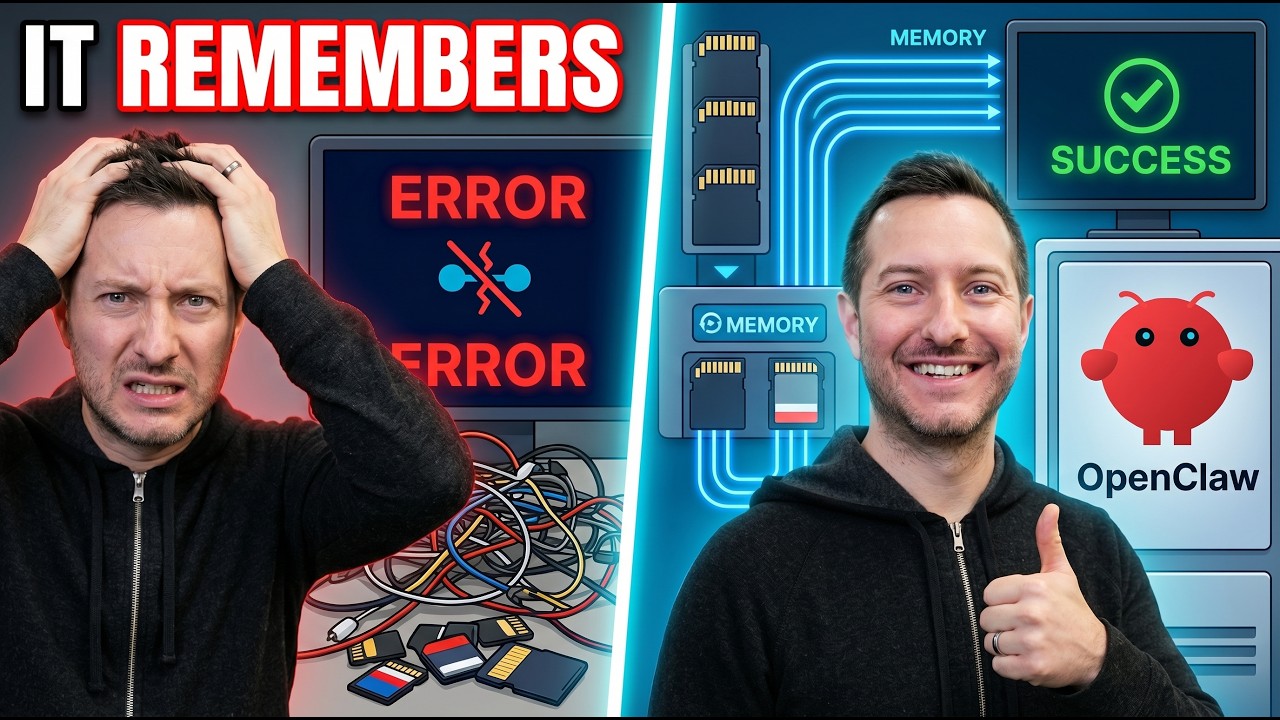
0:00In this video, we're going to be going over, yes, the newest Open Claw update 4.12 that just released. This is a big one though because it solves one of the main issues when it comes to memory. So, you've come across this problem before, I'm sure, that Open Claw just has a hard time remembering who you are, the mission that you're on, and the things that you're trying to achieve. I'm going to bring up the change log and go over what I'm talking about in particular, and then we're going to jump in to some of the features and some of the bugs they have fixed. Okay, the one thing I want to highlight here, and they just dropped this release a few hours ago. The main one that I really like is the active memory. So, it can add a new optional active memory plugin that gives your Open Claw a dedicated memory sub-agent right before the main reply.
0:45So, ongoing chats can automatically pull in relevant preferences, context, and past details without making users remember to manually say, "Remember this." This is something that I've been constantly doing out of habit. Or, you would have to say, "Search your memory. You remember we talked about this last week?" That got so annoying and so old so fast. I'm sure you've experienced it. But, it includes configurable message recent full context modes, and inspection, and advanced prop thinking, and it overrides for tuning and opt-in transcript persistence for debugging. Thanks, Tack Hoffman. There's a lot of other features here that we're going to get into in this video, but I wanted to highlight that because it is one of the biggest issues when it comes to AI
1:30agents in general. Yesterday, I made a video on G Brain, which is Gary Tan's solution to this problem, and I like to see that, you know, the whole Open Claw community is listening to the feedback and applying the changes. Let's get back into some of the other features that they shipped. I want to talk more on the fact on just how your AI agent doesn't seem to remember things and how annoying it can be. You know, you tell your agent how you like things done, you tell it your writing style, you tell it what project matters most. You tell it the same little preferences over and over, and then the next day, it just starts forgetting. Like, starting over from zero again, and it gets really annoying. So, what I like in Open Claw 4.12 is a pretty big deal with this active memory plugin because it pushes memory
2:15closer to what people actually wanted this whole time. Not a fake demo version of memory, not some clunky system where you have to stop what you're doing and manually go, search memory, and tell your agent over and over again, "You remember we talked about this last week?" have to go through this weird ritual where every few matches messages you have to remind your own agent who you are. This update adds something called active memory, and I love that because I think that this is one of the biggest quality of life upgrades in the whole Open Claw ecosystem. Here's the simple version. There are now new optional active memory plugins, and right before the agent replies to you, a dedicated memory sub-agent can fire off and go pull the stuff that actually matters for that moment. Preferences or
3:00contexts, or maybe people you had talked about, just basically all past details that are relevant in your history, things you already had told it, stuff that should be in the play, but normally gets lost unless you force the issue yourself. And that part matters. A lot of the times we have to go and tell our agent specifically, "Hey, last Wednesday, we worked on this project. I talked to Gary and all of this stuff about Gary, and you don't remember it." I've gone through that many times, and that's why I have so many different ways to back up for my system, and I'm sure you've gone through this as well. Now, with this active memory and sub-agent that only focuses on, you know, recall and memory and specific things. So, before it returns the response to you, it's going to spin off that fire fire
3:45off that sub-agent to return the result to you accurately because the pain was never that AI could not remember anything at all. It's the pain was in the workflow. It was the friction that caused this whole mess. that you had to baby-sit the memory system, like, every time you wanted a good output, you had to go and make sure it had the right context, and if you forgot, the answer got worse. The whole thing felt like owning a really smart employee who hit their head on a doorframe when they were younger. Open Claw 4.12 changes that. I'm loving it. Now, the memory can pull, it can happen automatically. Like, it can pull all of that relevant data before it returns the result to you. That happens right before every response, which I think's pretty cool. Because that is the exact moment it
4:31matters most. Not six steps earlier, not after the bad answer already happened, right before the reply. That means the agent has a chance to look at what you asked, go grab the most relevant background, and answer it like it actually knows you. You know, I still use Anthropic models in my Open Claw, and if I'm going in circles with my agent, that's just wasted money. I'm just wasting tokens on my agent failing to remember specific details about my business and who I am and what I'm trying to do, and that can cost a lot of money. So, this plugin, active memory in this latest update, if you're using Anthropic models, should also help you save on token spend. I think that this is the right design choice as well because memory should feel invisible when it works. You shouldn't not have to think about it. It should just make the
5:17conversation better. There are also configurable modes for how this works and how much context it pulls in before it gets the response to you, message recent or full context. So, if you want a lighter setup, you can just keep it narrow. If you're dealing with longer workflows and deeper personal contexts, you can open it up more. That flexibility matters because not every user wants the same level of recall, and not every machine or model setup needs the same memory footprint. I love this. It's going to be huge, and I always tell people before you update, make sure there's a feature in here that's worth upgrading to because if your system's working, keep it working. But, I really do think that this type of update to 4.12, on something that's before 4.7, where they started to work on a lot of
6:02the memory features, like the dreaming feature and um the memory wiki feature, this is worth upgrading to if you're having any type of memory issues. The other thing that I like here is the verbose inspection. You can actually inspect what it is pulling. So, because memory systems sound magical until they pull the wrong thing, and now your agent is confidently talking nonsense from 2 weeks ago. With verbose inspection, you can actually look under the hood and see what context it actually brought in. That gives you trust. It also gives you a way to debug things. And with agent systems, the ability to debug things matters way more than people think. You know what this reminds me of really? It reminds me of having a good assistant who keeps a notepad that actually checks it before they answer you. I mean,
6:48that's that simple system just in Open Claw. It's not someone who says, "Yeah, yeah, yeah, I got it." and then comes back five minutes later and just forgets what you said and does the exact opposite of what you told it. I have been there before with my Open Claw. So, for anyone building real workflows on Open Claw, I think active memory is worth the upgrade, and it's a feature they're going to keep on making better. But, that's not the only thing in 4.12. Um you know, I think that a lot of local first builders are going to really appreciate this upgrade too because the new LM Studio integration. This one is a sneaky little feature that probably won't get talked about much, but Open Claw now has built-in LM Studio as the provider. So, you can now run and test local models with an Open Claw. So, built-in support means the setup gets way cleaner, and it also supports
7:33runtime model discovery, which is really nice because your local environment is not always static. Models change, you swap in stuff in and out all the time. You test different local options. Open Claw being able to discover what is available at runtime makes the whole thing feel more real, less hard-coded. The bigger story through this, local models are getting good enough that people want to run more of their stack on their own hardware. Privacy, cost control, and speed, but just the fact of owning your own setup just feels good. And Open Claw is clearly leaning into that. Even the memory search embeddings can work with local models now, and that is a bigger signal than it might seem. I mean, if you're running a local model like Quinn, or now you could download GLM 5.1 if you have the memory
8:20bandwidth, to be able to just have it focus on memory, I think that is huge because costs are going to go up using these frontier models, and as well as hardware is going to go up. We need to start strategically strategically planning for that day because it's not going to get any cheaper. Hardware costs will not get cheaper. Using frontier models will not get cheaper. I mean, Chat GPT just upgraded to a $100 plan for using Code X and GPT 5.4. So, things are going to get more expensive. So, I'm just asking you, are you planning for local models? I know that's something that I've been working towards and wanting to do, and of course, I'm going to show the whole setup here on the channel, but it's just something to consider. You can't just rely all on Open AI or relying all on Anthropic, especially if you're going to run something more of like a agent as a
9:05service. Once memory works locally, I think this is going to change a lot of things, a lot of workflows, and the model routing actually works locally, and more Basically, if more of your stack works locally, you start getting closer to an agent that can actually live on your machine and actually be useful without piping every little thing through someone else's API. Now, is every local model suddenly perfect because of this update? No, we're still miles away, but let's not get carried away, and it does just remove the friction part. And I love seeing the vision of this going forward cuz we're moving closer and closer to a local model only system. It's just I feel like we're not there yet. You know, a lot of winning with AI right now is just removing the friction part. You know,
9:51the raw intelligence is only part of it. The setup of the quality matters most, and the workflow matters. And I think when you zoom out and look at it all, it's just all about reliability and consistency. Does this actually do the task that I want it to do? There is a new exec policy command, and this is more operational, but if you are serious about using agents safely, you should care about this one. Open Claw now has an Open Claw exec policy CLI with show, preset, and sub subcommands. I like this because agent permissions are one of those things people ignore until something weird happens. Then suddenly everyone wants a clear model for what is allowed, what needs approval, and how the local models approve file syncs up with actual behavior. With this update,
10:38exec config syncs with the local approvals file, and includes rollback safety. That's a pretty solid move. If you have ever changed a config and then immediately thought, you know, I may have just broken the trust model for my entire setup, rollback safety starts sounding very attractive. This is one of those less flashy features that makes the whole platform, you know, more mature, more production-ready. It's not a big flashy update, but it is very important. And while we're on the subject of safety, 412 also includes three patches. These are not just side notes, these actually matter. The first of the security patches is they removed BusyBox and ToyBox from safe interpreter bins. What does that mean? Is if something should not be broadly treated as safe, do not pretend it is safe. The
11:25second one is they fixed an issue where an empty approver list could grant explicit approval. Also a good fix because that I think is the kind of bug that sounds tiny right up until it's not. That can really destroy your system. The third thing is they blocked shell wrapper ENV ARGV injection. Again, this is the kind of fix that serious builders care about. It is not flashy, but if you're running agents that can actually do things on a machine, these fixes are the difference between a toy and something you can actually trust a little more. Like I said, it all goes back to building out agents as a service. You want to be able to have all this in place if you're actually going to build a service that serves another agency or another company, and I think security should not be overlooked. There
12:11are also dreaming fixes in this release. This was an update back in 4.7 when they started to roll out REM sleep and deep sleep. Also, heartbeat events are now consumed exactly once, and it stops dreaming from re-ingesting its own transcripts. So, if you have ever had an automation loop, and it goes weird on you, you know how important this is. Because once a system starts eating its own output and feeding it back into fresh input, things just get crazy. That's how things break. It is like making a photocopy of a photocopy, and then another copy, and it looks good at the first copy, and then it looks terrible by the third or fourth iteration, right? So, cleaning that up matters a lot more than it sounds. This should make like your background agent
12:56behavior more predictable, less weird duplication, less self-generated confusion, and just more clean event handling. There are also a couple other changes that are worth mentioning. Plugin loading is now narrowed to manifest-declared needs, which should help with faster startup. And there's also a commands.list RPC for remote command discovery, which opens the door for cleaner integrations and more dynamic remote setups. But let's be real, the reason most people are going to care about 412 is the active memory because that is the pain they feel every day. Not startup milliseconds, not even security patches, even though those are great, and even though those matter a lot. The thing is they feel is like having to repeat themselves to their own agent like they're training a goldfish with Wi-Fi. I think we've all been
13:41there. It's one of the most annoying things. And I think this update, you know, Open Claw is listening, the whole community is listening, and I think they feel like, yes, we know that this is like a constant problem. Let's fix it. And that matters because the best AI products are not always the ones with the smartest benchmark scores. A lot of the time, the winners are just the ones that remove the most annoying friction from normal use. They make the product feel yet less fragile, less needy, less like a demo, and more like a tool you can actually build your day around. If you are using Open Claw for content, operations, research, customer support, coding, I'm sure you're using it for much more than that. Just the fact that memory quality changes your whole system. It changes how often you trust the output. It changes how much hand-holding you need to do with your AI
14:27agent, and it changes whether the agent feels like a helper or a liability. And I think that's why 412 is a strong release. I do recommend updating it if you've ever had these memory issues in the past. Not because every single feature is like a giant one on its own, even though active memory I think is, but because the whole release pushes Open Claw into a more usable direction. Just the fact that it has better memory and better local support, better permissions all around, and better security, I mean, I think that's a real nice upgrade from 411. You know, this is also a good sign about where Open Claw is headed. They're not just shipping random stuff for hype, they're tightening the core loop. Make the agent remember better, make local models easier, make permissions clearer, make weird system behavior basically less
15:13weird, and that's how real tools mature. So, if you're already on Open Claw, I would pay attention to this update. And if you are not using 412 yet, I mean, it really makes the case stronger that this is becoming one of the most practical agent frameworks to watch. You know, I keep coming back to the one line in my head, no more manually saying, "Remember this." or "Search memory that." It just knows, and that is the dream. Not because it sounds cool, but because the it gets the friction out of the way, right? And it lets you focus on the actual work and not babysitting your agent. And I think that's what people want. They do not want to manage the memory system. They do not want the memory system to just fail and break all the time. It creates such inconsistent inconsistent flow, and you may end up
15:59building a project, making progress, and then having to have your agent remember constantly. It's just such a pain. Overall, I really do like 412, and the active memory is the whole star of the show. LM Studio support is nice, and it is a smart move. The exec policy command makes the platform a bit more serious. I do think that the security fixes matter as well. The dreaming part fixes the cleanup and stopping the weird behavior, and the smaller platform improvements keep pushing things forward. So, if Open Claw keeps shipping like this, the gap between a fun agent demo and a real daily operating system for work is actually going to keep shrinking and become more usable, which I love. And if you want to learn to build your first AI agent, or maybe you're sitting on the sidelines and you're figuring out how to install Open Claw, or you just want to
16:44build your first app, that's what we do inside the community. I launched the community 28 days ago. We have 219 members, and we do nine boot camp calls a week. So, the goal is for you to come into these boot camp calls, get your question answered, and be able to take the next step in your AI journey. We just integrated a new call in our whole class. It is focused on installing local models. So, maybe you have a beefy hardware, and you just don't know how to use it. We are now focusing on like, okay, let's start planning for the future. Let's develop a call that people can come in and go, "I have a 3 5090s. How do I get local models up and running on it?" That's what we're focusing on, and just basically helping you take the next step in your AI journey. If you haven't subscribed to the channel already, please do. We're going to start
17:30going live a little bit more, which I'm really excited about. My goal is to build it apps and help you guys, you know, learn the whole process of the tools and architecture that I use. We're going to do all of that live, you know, building all types of different apps, how to market my app, you know, using things like Hermes agent to help with marketing. So, I'm excited for the future. So, please hit subscribe, hit the notification bell, cuz we do drop videos like this about two to six times a day. It just depends. We'll see you on the next one. Have a blessed day. Bye-bye.
Build this with us, live
Shipping Skool is a free community with 4 live build sessions a week. Bring your idea.
Join Shipping Skool — Free




