Stop Overpaying for AI Agents - 4 Ways To Cut Costs
By Beau Johnson · · 15 min · 1.1K views
Chapters
- 0:00Intro and the real story
- 2:00What the financial bot does
- 4:00Why the Anthropic pricing change hit so hard
- 6:00The four things that drive up agent costs
- 7:00Context window bloat and compression
- 9:00Prompt caching explained
- 11:00Pulling only the delta
- 12:30Batching tool calls
- 14:00Architecture over model choice
- 16:00How to audit your own agents
About this video
Transcript
Read the full transcript
0:00In this video, I'm going to be talking about something that happened in the Open Claw community this week. That every builder running agents in production needs to hear this. Someone on Reddit posted that their Open Claw financial bot went from costing about $2 a day to about $20 a day almost overnight. What I really want to tell you is the part that came in after that. They got it back down to $2 a day, but I'm going to explain what he did specifically. I have the Reddit article linked down below. You should check it out. You know, in this video, I'm going to break down what exactly happened and why the cost spiked like they did and give you the exact playbook for keeping your agents alive when the bills start creeping up higher. Because I know things have for most of us running
0:46Entropic models inside of Open Claw, we're trying to find ways to be able to save money and cut costs here and there. For example, all of my cron jobs, all of my 17 AI agents that run this whole content pipeline, run on GPT 4, but my worker and coordination agent runs through Opus. And I also use Claude Code inside of my Open Claw in my mission control folders to help keep costs low. I can make a video about that in the future, but I want to explain how this case study really resonates with me and it should for you as well. You know, the post the post came from the Open Claw subreddit the other day and the title is "Reduce my Open Claw costs from $20 a day to $2 a day still using Sonnet." And I want to dig into this because it is a
1:31real story with a real number and a real outcome. I think it teaches something that most people running AI agents right now have not fully figured out yet. So, here's the setup. This person had been running a financial tracking bot for months now. The bot syncs their bank transactions. It sends a Telegram morning briefing every day with a spending summary and tracks their categories across accounts, which I think is pretty cool when you think about it. Most people pay $40 a month for some budgeting app like QuickBooks and they get a fraction of that customization they would get from building it themselves. This is a person that built their own with Open Claw and was running it for a couple bucks a day. And it worked great. Then the Entropic pricing change hit and their daily cost
2:18jumped from $20 to to overnight. Like $2 to $20 overnight. That's crazy. Real quick, before we keep going, if you're watching this and you want to actually build with some of these tools, not just watch videos about them, then you're going to want to check out our community down below, Shipping School. We have a full Claude Code course, a full Open Claw course, and four live bootcamps every single week where we actually help you get set up from scratch. [music] Like actually set this thing up, not just watch a tutorial and figure it out by yourself. And we also provide one-on-one coaching, so you could book a call with me. We could share screens and I can help you get Claude Code or Open Claw running on your machine. That's it, no fluff. I built this community because watching YouTube's only gets you so far.
3:04We launched it just 3 days ago and we have over 55 members. You need people around you who are actually building, people who hold you accountable, and coaches who can help you when you get stuck. I'll put the link in the description down below. Get in now before the price goes up. So, if you had been following what happened with Entropic pricing in April, here's the short version. Entropic adjusted how context is metered for long-running agentic workflows. You can no longer use your subscription plan to run Open Claw. You now have to pay through usage token, which can be very costly if you're using Opus or even Sonnet. You know, the way agents accumulate conversation history and carry it forward between turns got more expensive and that just happened within the last 2 weeks. Particularly
3:49for builders who had a large persistent memory file or were not being careful about what stayed in the context window across sessions. A lot of people saw costs quietly double or triple without making any changes to what their agent was actually doing. The agent did not get smarter. It did not get more powerful. It just got more expensive because the underlying pricing model changed. We were all so used to using Entropic models through the subscription and the OAuth token. So, when this hit just about 2 weeks ago, we had to find ways to cut costs and be able to, you know, outsource some of these smaller tasks to other models. I've done the same. I've been able to keep my costs lower than $1,000 this month, which is pretty awesome. But without optimizing,
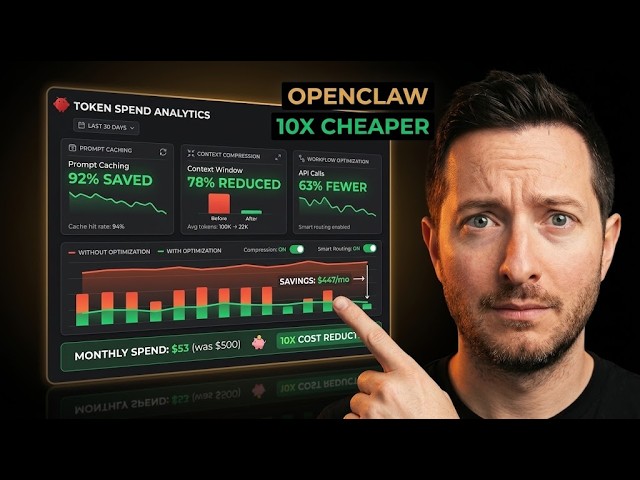
4:35I would have been spending two, $3,000 a month to run multiple business, this whole content machine, and that's just kind of out of reach, right? So, being able to cut costs and optimize tokens is where you're going to be seeing more and more for people who use Open Claw. You know, going from $2 a day to $20 a day doesn't sound like a lot, but for most of us getting started, we don't want to pay that, right? You know, that is a $500 a month difference when you come out to pricing it month over month. You know, from a personal finance tracker running on a Mac Mini, you know, that doesn't make sense, right? This person did what every builder should do when something breaks. They went back to first principles. They figured out what was actually driving the cost and then they fixed it. Here's what I want to do with the rest of this video. I want to
5:20use this story as the jumping off point for something that I think is genuinely useful to everybody. Because the four things that drive up costs in Open Claw agents are almost always the same four things. And once you understand them, you can audit any agent you're running right now and find where it's spending the most money. The first thing is your context window bloat. This is the biggest one and it catches the most people. In Open Claw, your agent has a running conversation. Every turn, that conversation includes everything. All of the context, the system prompt, the current message, all of the previous messages, the tool results, the memory files that got loaded. And as an agent
6:05runs more turns across time, especially one that fires a cron schedule and carries history forward, that context window just keeps growing. And here is the thing that most people miss completely. You pay for the full context window on every single API call. So, if your agent has been running for months and has a large conversation history, you are paying for that entire history every single time it wakes up. That is where the person that was building this was bleeding money. So, the fix for context window bloat is compression. You know, you have your agent write a summary at the end of each session and store it to a file. That's what Lossless Claude plugin does and it does a really good job at handling compaction events. I guarantee that if you install this plugin, it's going to help your agent
6:51not only remember, but you're not going to spend as much money. I compact when I hit $200,000 200,000 token context window and I can go to a million, right? Because I'm using Opus. But I don't have to go to a million. I compact after 200,000. It just helps save money, keeps the sessions short and brief, and I can usually figure out, you know, what to do and go from there. You know, basically, the next time your agent runs, it will read the summary instead of the raw history. So, if you go through a compaction event and get Lossless Claude installed, that's what it will do going forward. And you can set it to 300,000, 200,000, whatever LLM you're using. So, instead of carrying tens of thousands of tokens of conversation forward, you carry, you know, maybe 200,000 tokens of
7:37compressed insight. Same useful information, way cheaper token bill. And the beauty of this is you're not losing anything. You are distilling the information. Your agent gets the context it needs to do the job without dragging the full weight of every previous turn into each new session. The second thing is not using prompt caching. Open Claw and Claude both support caching for your system prompt. Your agent instructions, your persona file, your tool definitions, they do not change between runs. So, if you mark them for caching, you pay for them once and get a significant discount on every subsequent turn. For agents running on cron schedules that fire multiple times a day, this alone can cut cut costs by 30 to 40%. I see people skip this all the
8:22time because it requires a small configuration change and they think they will get it done later. Don't do it later. Do it now. It is one of the highest return optimizations available and it takes about 10 minutes to set up. The third thing is pulling into too much data every run. A lot of people build their agents to be thorough. Every run can read all the memory files, check all the connected sources, and load all of the context. And during development, that makes a lot of sense, but you want to make sure that the agent has everything it needs. In production, most of that data is not changing every run. Your financial bot does not need to reread your entire transaction history every morning. It needs to pull in the new transactions since yesterday and that's it. The delta, not the whole
9:07database. You know, when you audit your agent and you look at what actually gets loaded into context on every turn, you usually find things that were necessary during the setup, but are no longer necessary for the actual job. Cut that stuff out. Your agent only needs what it needs to do its job right now, not everything it has ever seen in the whole database. The fourth thing is unnecessary tool calls. Every tool call is a turn. Every turn carries the full context. If your agent is making 10 separate API calls to build a morning briefing when it can just get the same result in three well-structured calls, you are paying for 10 context loads instead of three. So, think about batching. Think about what information you actually need and what is just nice
9:52to have. For a financial bot specifically, this is often where the big wins live. You can pull balances, transactions, and category totals in one structured call instead of three separate ones. Fewer turns means fewer total tokens build, and the difference adds up fast when your agent is running every single day. Now, here's the thing that I really want you to take away from this story is this person did not switch to a cheaper model at all. They kept running Sonnet 4.6. If you're struggling to keep up with content, well, I'm about to save you about 40 days worth of work. I built something called content machine. It's 10 [music] AI agents that run on the open claw orchestration, and they handle everything. Scripts, [music] thumbnails, X posts, blogs, outreach, clips, newsletters, all of it. So, I
10:39went from 1,000 subscribers to 4,000 subscribers on YouTube in 7 days using this exact system. Every single morning, I wake up, [music] and the content's already done. I spend maybe 15, 20 minutes reviewing and approving them, and I move on with my day. [music] It works for any niche, fitness, finance, real estate, marketing, whatever you are building, and it is 100% completely customizable to your use case. [music] So, you get the mission control dashboard, all of the cron jobs, everything I've built over the last 40 days helping me gain more and more people to subscribe and join the community. So, you plug in your own thing, and it molds it to you, it learns how you talk, and it writes [music] so it doesn't sound like AI slop. $97 one
11:25time, it's not a subscription. I'll put the link down below, and you'll thank me later. The fix was not about the model at all. It was about the architecture, and that is the lesson I think is worth saying out loud because the reflex when cost spike is usually to reach for the cheaper model first. Don't do that. You know, people are hoping to downgrade and hope for the best. If you're trying to sell agents as a service, you want the best quality output. You know, sometimes that is the right call, but very few times it is. You know, more often the real opportunity is how you design the agent in the first place. You can get a 90% cost reduction on the same model just by being more deliberate about what gets loaded in the context on each turn. Whether you are using caching or how many turns it takes your agent to get
12:11through its workflow, I keep coming back to this with school members who are building their first AI agents. The model is not the first variable you should be optimizing. The architecture is. The memory. How is it doing prompt caching? How is your architecture look? What are you using? Opus? Sonnet? What are you building? Did your cron jobs run on Opus? Don't do that. You know, get the architecture right, and the model almost does not matter from a cost perspective. You know, a well-designed agent on Sonnet is going to be cheaper and more capable than a badly designed agent on Haiku. So, if you're running an open claw agent right now and the bills have been creeping up, do this audit this week. Pull up your agent logs, look at your average context size per turn, and check whether your system prompt is
12:56cached. Think about what your agent loads on every run, and whether all of it is actually necessary. And then count your tool calls per session and see if there's batching you can do. And the next step is give this link to this video to your AI agent and suit say, "Do everything that this person is saying because I don't want to spend as much money." That's what I've been doing lately. Anytime I come across a good GitHub repo or a skill or a YouTube video, I have my agent say, "Hey, is there anything in this video in this repo that we're not doing that we can help optimize for?" I'm telling you right now, do it because people are spending too much money, and they're giving up and not figuring out ways to optimize their architecture. You know, these four things together, like context compression, prompt caching, pulling the old delta, and batching the tool calls
13:43should get most builders back to a reasonable number without sacrificing any functionality. The story from this week proves it's possible. Someone had a real production agent that had been running for months. They hit a pricing wall, did the work, and came out paying 10 times less for the same result. That is what building in public and learning in public actually looks like. If you want help this with this type of stuff, you know, like optimizing your workflow, or you want to share what you've built and get eyes on it in front of people who are doing eight, nine, 10 figures a year, come join us in Shipping School. The link is in the description. We have members running everything from finance bots to content pipelines, and we talk about this stuff nine times a week live in our boot camp calls. If you haven't subscribed to the channel too, please do so already. We release about one to 10 videos a day, depends on what's
14:29happening in the news. Please subscribe, hit the notification bell, and we'll see you in the community. Bye-bye.
Build this with us, live
Shipping Skool is a free community with 4 live build sessions a week. Bring your idea.
Join Shipping Skool — Free




