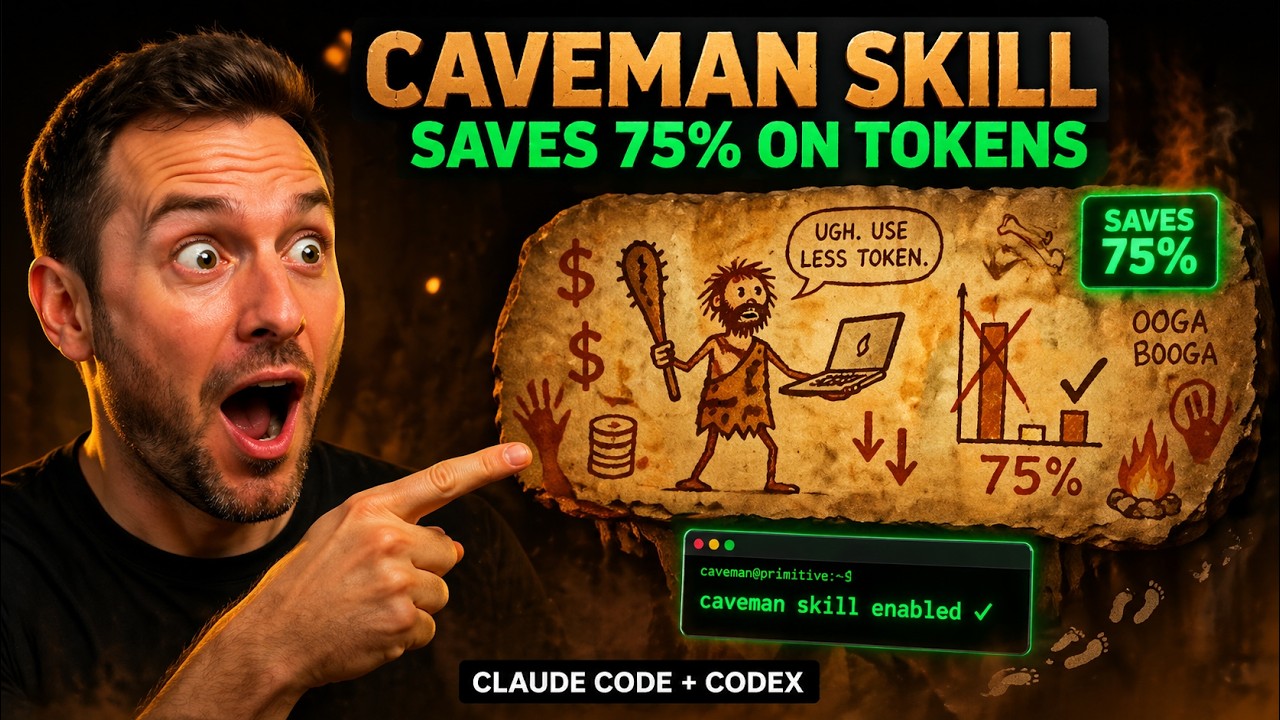
This Skill Saves Claude Tokens By 75%
By Beau Johnson · · 14 min · 857 views
Chapters
- 0:00The trick that just hit X this morning
- 1:00Why Claude Code burns tokens nobody talks about
- 2:30What the Caveman skill actually does
- 4:00Why 75 percent savings is even bigger than it sounds
- 6:00Who benefits the most from this
- 8:00The real builder lesson hiding under this trick
- 9:30Instrumenting your own stack
- 10:30Why this is the moment to start shipping
- 11:30Final thoughts and CTA
About this video
Transcript
Read the full transcript
0:00So, there's this skill on GitHub right now that is going to save your Claude token spend by 80%. Let me show you. And the skill is called the Caveman skill. And I know what you're saying, come on, is this even real? 50,000 GitHub stars in the last month. So, why use many token when few token do trick? Essentially, it just responds to you as a caveman would, cutting down on a ton of token spend. It says it cuts it up to 65%. So, if you go to the actual website, get Caveman, it's a token efficient stack for agent native development. So, you can plug this skill in to your Claude code and start saving money instantly. I know a big deal has been made with people hitting their
0:45usage limits using their Claude subscription, whether it's an open Claude or just heavy Claude code usage. This is a skill that you can use today to help it so you never hit your usage limit. So, a Claude code skill plugin and a code X plugin that basically makes your agent talk like a caveman, cutting 75% of the output tokens while keeping full technical accuracy. So, that is pretty impressive based on viral observation that caveman speak dramatically reduces LLM token usage without losing technical substance. So, this is an easy one-click install. I'll put the repo down below. You need to check it out. And the reason why this skill is moving so fast is because it
1:31solves a problem every builder experiences, especially if you're using Claude code. You know, you know how it goes. I know if you've built with Claude before, you know exactly what I'm talking about. You sit down to build something, you start a Claude code session, and you're ready to work. You know, you give it a real task, and you feel like something's working, you're actually making progress. You know, you start maybe say, "Hey, fix this bug or refactor a function, add this feature into your workflow." And Claude code starts doing the work, and you start getting impressed, which is awesome. And that happens nine times out of 10, and that's why we use it. But then, you notice something. Halfway through your session, you start seeing those rate limit warnings. We all get them. Or maybe like your response slows down and
2:16gets bogged down because the context is bloated. Or you get to the end of your day, and you look at your usage, and you start to freak out a little bit because they have a 5-hour session usage and a weekly usage. You can very well hit your weekly usage in one day's worth of work. You know, and you're asking yourself, "Did I really just burn through my weekly usage in one day?" This has been a common theme over the last month when using Claude code. You know, here's the thing that no one talks about enough, really, is Claude code is amazing. We all know that, but it's also really chatty back and forth, especially if you have an open Claude setup and your user and your identity markdown files are not built out to just give you a strict direct response. Real quick, before we
3:01keep going, if you're watching this and you want to actually build with some of these tools, not just watch videos about them, then you're going to want to check out our community down below, Shipping School. We have a full Claude code course, a full open Claude course, and four live bootcamps every single week where we actually help you get set up from scratch. [music] Like actually set this thing up, not just watch a tutorial and figure it out by yourself. And we also provide one-on-one coaching, so you could book a call with me. We can share screens, and I can help you get Claude code or open Claude running on your machine. That's it, no fluff. I built this community because watching YouTube's only gets you so far. We launched it just 3 days ago, and we have over 55 members. You need people around you who are actually
3:47building, people who hold you accountable, and coaches who can help you when you get stuck. I'll put the link in the description down below. Get in now before the price goes up. And that can actually end up killing you in the long run because it ends up using a lot of tokens. You know, a chatty AI agent equals a ton of token spend, and tokens equal money and rate limits that you're paying for. You know, the model wants to explain itself, right? It wants to walk you through its reasoning. It wants to be polite, I get it. And it says things like, you know, "I see you're working on the next authentication module." Or "Let me first read the relevant files and analyze the current implementation before suggesting changes." I get that all the time. And that sentence alone is probably 30 tokens. Multiply that across by an
4:338-hour build session, and you're paying for a lot of polite filler that doesn't actually move your project forward. So, this is where the Caveman skill comes in. And this skill forces your Claude code agent to talk like a caveman. And that's what it's called, the Caveman skill. It actually works exactly how it sounds. So, instead of a normal verbose response, the agent gives you something like "Bug in off. Token wrong. Fix line 42. Three short bursts. No filler. No throat clearing." It's just the answer, which is hilarious at first, but pretty cool in the long run. And I know what you're thinking, you know, this sounds pretty stupid. It sounds like a joke. Um, but hear me out for a minute. I thought the same thing for a few seconds. Then I read the actual numbers.
5:20There is a report of 75% reduction in token usage with the same accuracy. This isn't like a 10 or a 25% reduction. It's up to 75% reduction. Three-quarters of every Claude code response was filler that the model could have skipped without losing any of the actual problem-solving. And that's pretty crazy when you think about it. It means most of what we have been paying for, most of what has been clogging up our context windows, was just verbosity for the sake of verbosity and just too much garbled junk. I get it, it's trying to be nice, it's trying to be personable, but it doesn't actually move our project forward and ends up costing us in the long run. So, I want to be clear about why this works because at first glance you might think, "Well, of course, shorter responses use fewer tokens, duh,
6:06it's just math." But the reason it actually matters is much deeper than that. So, when Claude code or any agent generates like a verbose verbose output, there's two things that are happening under the hood there. First is like you pay for the output tokens at the model provider rate. That's the obvious one, right? But the second thing is the bigger problem. Those tokens then become a part of the conversation history that keeps being fed back in with every single query. So, the next time the agent needs to think, it has to read all the previous filler, which means you pay for those tokens again, over and over and over until you compact or start a new session. So, a 200 token explanation in one turn becomes a 200 token input
6:53cost in every following turn until the session ends or you go through the compaction event. So, a 75% cut in output tokens isn't really a 75% savings, it's way bigger because of the compounding context cost. Every turn after the cut is also much smaller. So, your session lasts longer, your agent thinks faster because it has less garbage to go through, and your bill at the end of the day looks like a different bill entirely. Your usage limits will not get hit as often as they would have without this skill. So, let's talk about who this matters for. If you are in a school community like us, in our Shipping School community, and you're running a content pipeline with
7:38multiple agents, you have probably already had the rate limit conversation with yourself. You started with one agent doing one thing, then you added another and another, then five, then 30 agents in, and somewhere along the way the daily cost added up. This is the exact moment where a skill like Caveman starts paying real dividends in your setup. You're not just saving money, you're unlocking room for more agents and agentic workflows to run without rate limit throttling. So, if you are a solar builder using Claude code to ship your next SaaS or an internal tool, the math is different, but the impact is the same. Right now, you probably have a daily token budget that you try not to hit every day. Maybe you hit it around 3:00 p.m., and you have to wait for that
8:245-hour window to reset. That's annoying. With something like Caveman, you might not even hit it at all. So, which means there's more shipping that you can do in every session, which means you get faster feedback, which means you get a better product overall, which is the whole goal, right? So, if you're an agency or a freelancer charging clients for AI work, this is actually a really big unfair advantage. You can charge the same rate and deliver the same outcome, and your margin just went up by 75% on the AI cost. So, that's not a small number. That's a number that pays for the next hire or the next subscription or the next month of runway. So, here's what I want you to take away from this and how you can actually use it. The next moat for builders is not better
9:09models at all. We have been chasing better models for 2 years straight now. I think they're all pretty good at this point. Every time a new one drops, we celebrate, and then we use it the same way we use the last one. And we hit the same walls even. The actual moat is how you talk to the model. It's the prompts, it's the skills, the formatting, the context strategy. You know, this isn't just like some revolutionary thing. This is something we've been seeing for the last few months. So, this is 75% token saved. I mean, come on. If you're struggling to keep up with content, what I'm about to save you about 40 days worth of work. >> [music] >> I built something called Content Machine. It's 10 AI agents that run on the open Claude orchestration, and they handle everything. Scripts, thumbnails,
9:54X posts, blogs, outreach, clips, newsletters, all of it. So, I went from 1,000 subscribers to 4,000 subscribers on YouTube in 7 days using this exact system. Every single morning, I wake up [music] and the content's already done. I spend maybe 15, 20 minutes reviewing and approving them and I move on with my day. It works for any niche, fitness, finance, real estate, marketing, whatever you are building and it is 100% completely customizable to your use case. So, you get the mission control dashboard, all of the cron jobs, everything I've built over the last 40 days helping me gain more and more people to subscribe and join the community. So, you plug in your own thing and it molds it to you, it learns
10:39how you talk and it writes so it doesn't sound like AI slop. $97 one time, it's not a subscription. I'll put the link down below and you'll thank me later. That's the lesson. Look at your stack right now. Look at every prompt your agents are using. Look at the system messages, look at the skill files. Most of them are verbose because he wrote them when the context was cheap and the rate limits felt theoretical. They're not theoretical anymore. Everyone's hitting their limits. The Anthropic pricing changes earlier this month made that real for everyone. And also too, this works for Codex. People been loving Codex. Codex has that new app that you can download and run agentic workflows. Download this skill and use it. You know, go in there with fresh eyes, go into your setup and ask what could be
11:24shorter, what could be fragmented instead of a sentence, what filler is the agent generating that I don't need. You know, I'm going to do this myself with my whole setup today and just redo the whole thing. I'm going to get the skill going and we're going to look at what other prompts are way too lengthy that just end up costing too much tokens and how can we be saving more money? For example, like I have 17 agents, most of them are named after the Wu-Tang Clan, but for example, like the RZA, Inspectah Deck, U-God, Method Man, Ghostface, every single one of those agents, I actually want to see how much I could shave off without losing any of the output quality. I'll probably do a follow-up video and, you know, explain how it's ended up saving tokens and what our token spend is on a daily average today versus after installing the skill,
12:10you know, and just see what worked. You know, there is a deeper builder lesson that's sitting under this one as well. The Caveman skill works because somebody actually paid attention to where the costs were leaking. Most of us never look at the prompts after we write them. We ship a skill that works and then we move on. The Anthropic pricing change was a huge wake-up call. Suddenly, people started instrumenting their own stacks, logging every call, watching the token meter every minute and the second they did that, opportunities like this one got obvious. The leverage point was sitting right there the whole time. We just needed a whole change up in our workflow. That tells me something more important here. The builders who are going to win in the next 12 months are not the ones who chase every model release. They are the ones who instrument their setups, watch for the
12:55actual numbers and find the obvious 75% savings sitting right there in sight. That's the mindset shift from chasing tools to measuring what you already have is the actual difference between a hobby project and a sustainable AI business. So, if you want to grab that skill, I'll put it down below. The link is in description. Read the whole thread. Try it out on a real task. See what happens to your token count. And the answer is going to be pretty crazy. If you're watching this and you don't have an agent stack yet, you do not have a Claude code routine yet, you're not even building daily, this is the time to start because the people who are already building are about to get even faster. The compounding gap is only going to widen the longer that you wait to start shipping your idea, the bigger this gap gets. So, get in the door, pick a
13:40project, pick a skill, pick a tool and just ship something. Create a landing page, create a walking app, create a looks maxing maxing app. I don't care. Whatever you want to do, whatever your thing is, get going cuz the time is only an opportunity at this point. And it only looks like an opportunity in hindsight. We're moving fast in this space. You got to at least get going. Start using the tools. So, and if you want help getting started, we have a community with over 200 builders inside of Shipping School. We launched it about 35 days ago now and we do nine classes a week. We also do unlimited one-on-one coaching calls. So, if you need help, we can share screens and we can help you take the next step in your AI journey. I'll put the link to the group down below as well. And if you haven't subscribed to the channel already, please do because we release videos just like this every single day. We'll see in
14:26the next one. Have a blessed day.
Build this with us, live
Shipping Skool is a free community with 4 live build sessions a week. Bring your idea.
Join Shipping Skool — Free


