Why You Should Use Fusion for Better AI Results
By Beau Johnson · · 23 min · 2.9K views
Chapters
About this video
Transcript
Read the full transcript
0:00All right, so one model is not the strategy anymore. And that's the whole point of this video. With Claude of Fable getting banned just last week, you've seen a Kimi K 2.7 come out, the new GLM model come out. These companies are shipping faster more than ever to take back market share. No one's really talking about the open router model that just dropped called Fusion. You know, everyone's always about Claude versus GPT, GPT versus Google and all that. And I hear you. It's great to have some competition. It makes these models much better. But this is a sneaky model I want to go through here. It says we found that synthesizing the result of multiple models can significantly outperform what individual models are
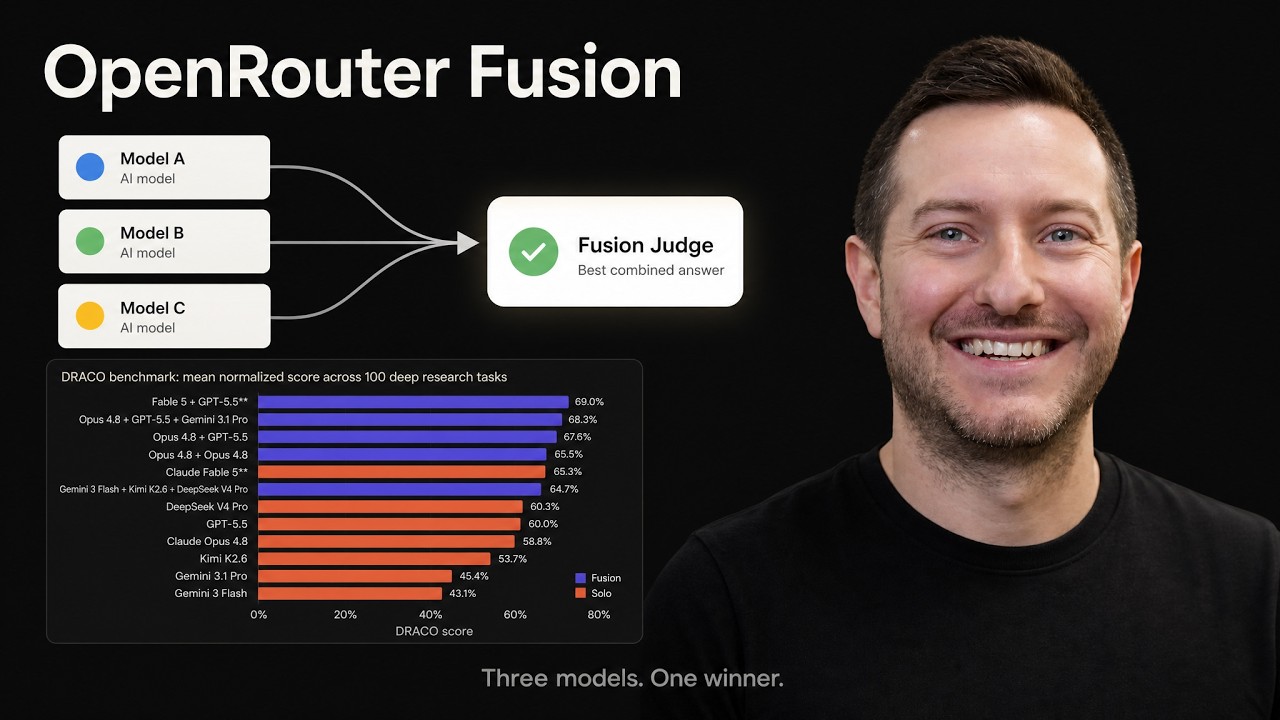
0:46capable of. So they're introducing Fusion here. It's a tool for getting these combined results just as easily as calling a single model. So that's what this video is all about. I want to talk about it a little bit about it today because people are scrounging because we got so used to using Fable. Now we're figuring out, oh great, going back to Opus 48, it's just so much different. Even though it's still a good model, everyone's trying to find that alternative. So like I said, they launched Fusion. And the idea is really simple here. It's instead of asking one model to be right all the time, you basically send the same hard problem to a panel of models. And then you let them research in parallel. Then let that judge model compare the answers and then
1:31synthesize the final response. I love that. So in this video, I'm going to be talking about why this really matters for builders and why I do not think this is just another model drop or a model wrapper and how I'd actually use it in my workflow. So you can see here, OpenRouter Fusion surpasses frontier performance. Let's just open this in a new tab and then we can see it better. You you see here, um, OpenRouter Fusion surpasses the Frontier performance. That's awesome. So, like I said, we all got really used to using Fable 5, and while I do think it is coming back, you know, this is interesting. It's just a way for be able to, number one, save on token costs, but also to maximize the power of these models. So, let's see. Let's go into it more here. It says,
2:17"Seven of the 100 Draco tasks were not completed because Fable 5 content filters blocked them from executing. So, we chose not to fall back to Opus 4.8 for those tasks. So, the Fable results reflected 93 scored tasks rather than the full 100." You could see it here in the performance versus the cost. You could see, obviously, Fable 5 was amazing, and performance versus cost of Fusion, I mean, ranks really high. I mean, as far as cost, it's amazing. I want to go more into this post. It's called "Surpassing Frontier Performance with Fusion." And it was just published 4 days ago, so I'm a little late to the game. I'll put this link down below, and, you know, there's a lot of good
3:03benchmarks here that just show the capability of Fusion. Real quick, before we keep going, if you're watching this and you want to actually build with some of these tools, not just watch videos about them, then you're going to want to check out our community down below, Shipping School. We have a full Claude code course, a full Open Claude course, and four live boot camps every single week, where we actually help you get set up from scratch. Like, actually set this thing up. Not just watch a tutorial and figure it out by yourself. And we also provide one-on-one coaching, so you could book a call with me, we could share screens, and I can help you get Claude code or Open Claude running on your machine. That's it. No fluff. I built this community because watching YouTube's only gets you so far. We launched it just 3 days ago, and we have
3:50over 55 members. You need people around you who are actually building, people who hold you accountable, and coaches who can help you when you get stuck. I'll put the link in the description down below. Get in now before the price goes up. Basically, the headline claim to just summarize it for you is OpenRouter says panels of models consistently outperform individual models on the deep research task. So, if you were like refactoring your codebase or running a heavy migration, this is something that you might consider implementing. OpenRouter did not just say that, you know, in a tweet. They actually came out and publicly acknowledge this. You know, they tested Fusion on 100 deep research tasks. And
4:35from those Draco benchmark scores, I mean, which is designed to test the reasoning, the tool use, the knowledge, citation, and quality synthesis, in that test, the best results they showed, and I know this is a little late to the game, Fable has been banned, but Fable 5 plus GPT-5.5 together, synthesized by Opus 4.8, scoring a 69%. So, you could see here Fusion, Fable 5 plus 5.5 GPT, and then uh synthesized by Opus, you got a 69%. I mean, that is remarkable. So, Fable 5 alone scored 65% in that same OpenRouter report. GPT-5.5 also, you could see here, scored 60% by itself. Claude Opus
5:234.8 scored 58%. So, you can see it, 10% jump is pretty good when it comes to these reasoning and tool use benchmarks. The the part that I think really that us builders should pay attention to here is like a budget panel made of Gemini 3 Flash, Kimmy K 2.6, DeepSeek, all of them scored 64.7%, which OpenRouter says basically beat GPT 5.5 and Opus 48 and came within 1% of Fable 5 while costing 50% less. That's crazy. That's the shift here, I think. You know, we're all figuring out how we can save on tokens, maximize our token usage. And that's the cool part, is not one expensive model is
6:08trying to do everything here. A small team of models, each taking a swing, then a judge pulling out the consensus, contradictions, blind spots, and unique insights. And like if you're building with agents at all, that should immediately make your brain start churning. And this is how humans basically already work, right? If I have a big decision, I do not ask just one person and call it done. I want to check and verify that they actually know what they're talking about. I'll ask the operator, I'll ask an engineer, I'll ask a finance person, I'll ask the person who's going to break the thing in production, right? You're going to want to have like a standard operating procedure. And then I will take all of that data and look for the pattern. That is basically what this fusion model is trying to do, but for AI responses. The
6:55docs basically explain the pipeline pretty cleanly. The OpenRouter Fusion Server Tool lets a model call a multimodal deliberation tool. A panel then answers in parallel and a judge compares their responses. Then a structured analysis comes back to the original model for the final answer. This is why you see a huge thing happening right now with looping. Looping is also a similar type of strategy to help, you know, not have to prompt basically anymore. And I do believe that is the future of building with AI is you're going to see prompting kind of go away. I know that's a hot take, but I do believe it. And I'll put this link down below, too. This basically just goes more in detail about
7:41how fusion actually works. The open router fusion server tool gives any model access to multimodal deliberation. So basically when your model decides a prompt, it benefits from multiple perspectives. It invokes this tool a panel models answers in parallel. A judge compares their responses and the structured analysis comes back to your model for the final answer. So you can see there's a quick start here and then when does the model invoke it? It says the tools description tells the model to call open router fusion only when a task generally benefits from multi perspectives. I love that. So this is something that you could use to be able to help save on your token costs and as well just to experiment now that we don't have fable 5 anymore and just see
8:27how well it performs. Give it give Opus 4.8 give GPT 5.5 on extra high and then give this fusion model the same task just to see how well it performs. So the panel can essentially be one to eight models. Each panel model gets web search and web fetch enabled which is pretty cool. And the judge returns consensus points, contradictions, partial coverage, unique insights and blind spots. So that is not just a nice answer. That is a different shape of output all together and it is going to change how builders build. A normal model will basically just give you one confident thread. Fusion gives you a disagreement map like a road map. So that matters because most agent failures
9:13do not happen because the model can't write words. They happen because the model is confidentially missing something which is super annoying when building with AI. You know, maybe it misses a security risk or maybe it picks the wrong architecture to build out your whole project and it could even assume an API works one way when the docs say it's supposed to be implemented a different way. I've had this happen many times when building easy flip when connecting to the eBay API. That was also on Opus 4.1, so it could also, you know, maybe it solves the obvious problem and ignores the weird edge cases. You I know you go through this all the time, but with fusion, you know, the value is not only the final answer
10:00here, the value is seeing what models they disagreed about. That is why don't think that this is for every prompt you should be sending through. It says when some models error, but at least one succeeds, the result still has the status okay, and then it adds a failed models array describing which ones failed and why. So, that has judge degradation here. So, if a panel succeeds, but the judge fails, an upstream error, an empty completion, or an output that isn't valid JSON analysis, the tool does not error. Okay, and that's why I don't think this is for every prompt you need to be sending through. You know, OpenRouter is basically saying that this tool should be only used when the task benefits from multiple perspectives, like like a
10:46research question or a multi-domain critique, compare and contrast prompts, or anything where like being wrong is can be expensive. So, if we had Fable, this is where you probably have it as an alternative. They also say simple tactical prompts should not trigger it, and that's exactly how I would use it. It's like if I'm making an agent to rename a file, I don't need the whole boardroom going at it. If I'm asking an agent to choose architecture for a paid product, or migrate a database like I said earlier, or compare vendors, review security tradeoffs, basically decide whether to build on top of a new API, then yes, like I want multiple models arguing before I spend real time or real money. This is why benchmark choice
11:31matters here. Open router used the Draco because it tests deep research tasks across 10 domains including academic research, finance, law, medicine, technology, back-end design, and just general knowledge overall. And you could see it right here surpassing frontier performance in the article I posted. It's like >> If you're struggling to keep up with content, well, I'm about to save you about 40 days worth of work. [music] I built something called Content Machine. It's 10 AI agents that run on the Open Claw orchestration, and they handle everything. Scripts, thumbnails, X [music] posts, blogs, outreach, clips, newsletters, all of it. So, I went from 1,000 subscribers to 4,000 subscribers
12:16on YouTube in 7 days using this exact system. Every single morning I wake up, [music] and the content's already done. I spend maybe 15-20 minutes reviewing and approving them, and I move on with my day. [music] It works for any niche, fitness, finance, real estate, marketing, whatever you are building, and it is 100% completely customizable to your [music] use case. So, you get the mission control dashboard, all of the cron jobs, everything I've built over the last 40 days helping me gain more and more people to subscribe and join the community. So, you plug in your own thing, and it molds it to you. It learns how you talk, and it writes [music] so it doesn't sound like AI slop. $97 one time, it's not a subscription. >> I'll put the link down below, and you'll
13:01thank me later. These panel of models are kicking butt. I mean, Fable 5 with GPT 5.5, I mean, you can see it here combined outperforms any other solo model. The Open Router post says each Draco task has a rubric with roughly 39 weighted criterias across factual accuracy, breadth and depth, presentation quality, and citation quality. And that's important because most benchmarks do not look like a real builder work at all. That's why there's a big difference between benchmarking and actual production work. There needs to be a separation between the two. The benchmarks get the clicks. They're the marketing strategy, especially targeted towards us as builders. We see a benchmark and we go, "Wow." Well, how does it actually perform? That is huge
13:48and it is the most important because most benchmarks are just like fake. You know, it's like GLM came out with their newest model and Kim E K 2.7 came out with their newest model, but can you actually let it go on production databases? I don't think so. Real builder work is really messy anyways. Like if you're comparing docs, pricing, rate limits, security issues, and product tradeoffs, and you throw in edge cases, you are not answering one clean multiple-choice question. So, when I see a tool that improves research, synthesis, contradiction detection, and citation quality, I do care a lot more than if it just wins one puzzle benchmark cuz when they run it through the benchmark test, they're basically just testing it on one thing. There is a catch here. Fusion isn't magic and if
14:34you've used it, you know so. OpenRouter says server tools are currently just in beta right now and the API and behavior may change. So, they also do say Fusion is not a drop-in replacement for Fable or Opus 48 because the benchmark covers deep research and does not cover long horizon tasks where Fable does shine. And that's the honest take here, you know, do not replace your coding agent with Fusion and expect it to run the whole repo migration by itself, but I would use it as a high judgment tool inside of your workflow. And OpenRouter does say, you know, use it for coding and that's the basic thing, right? Fusion should not just be a replacement for everything. Fusion should be a
15:19a server tool that the base coding model can call selectively for architecture decisions or best practice research. And that is exactly the lane that I would put this in. And if you think of it like this, your coding agent still writes the code, but Fusion helps it make the expensive decisions before it actually writes the code. So, things like architecture, security, vendor choice, debug strategy, and migration plans, that's what it should be used for. Should we use Postgres row level security or application permissions here? Should I run this queue or on a cron job? Should we trust this library? And what did the docs say that one model miss? That is where I want the panel. That is where I want the models arguing
16:04over. And there are free ways to use it. The first way is the OpenRouter Fusion model alias. The second way is just the Fusion plugin. And then the third way is the OpenRouter Fusion server tool, where your selecting model can decide when to call Fusion. The server tool is the most interesting one for agent builders because you can put it inside of a larger agent loop. These agent loops are becoming more and more popular, and that is where I would specifically put it in my workflow. If you're currently running a loop, integrate this Fusion model to help these agents argue and make sure your loops are done cleanly. It will also help you save on token spend. You could keep your fast model for normal work, and then let it escalate hard decisions to Fusion when the cost of
16:51being wrong is super high. Like, if you're using Fable 5 when it comes out, I do believe it will come back. That model is going to be insanely expensive if they end up going to usage-based credits, because they did just give us a sneak peek of its power and promise through the subscription. But if it does come back, you're going to want to use something that's going to help you save on token costs. And that is basically the agent pattern I keep coming back to. You keep the fast for the default and then the expensive stuff for escalation. And then you want evidence before you actually take action. This is where a lot of builders are messing up right now. They pick one model as the brain for everything. Then they blame the model when it makes one bad decision. But the real problem is actually the system design. And this is why agent
17:37loops are taking off right now because they have that recursive feedback loop. If every task goes through one brain and if you have just one agent without a loop and you have one prompt and one answer, you do not have an agent system. You just basically have a chatbot that has access to tools. You know, a real system needs actual routing. It needs like checks. It needs memories. It needs escalation. You know, what happens when something goes wrong? It needs a way to basically say, "This answer is too important to trust on one first pass." Fusion gives you that clean piece of that stack that you can integrate in your workflow today. Now, I want to point out something that Open Router did right in this benchmark. They actually found a panel of models that have web search and the models could discover the
18:22Draco grading rubric online, which does create contamination risk. Open Router says that they fixed it by excluding locations where benchmark results are hosted from web search and web fetch. That matters because this is the kind of detail that most AI hype posts can skip past. Like if your eval can be cheated on by search, your eval is not telling you very much. The fact that they called out makes me trust the write-up a little bit more, not less. I mean, they're being transparent here. Another interesting result is that Opus 4.8 fused with itself scored a 65.5% pretty crazy and I thought that was interesting, which is like a 6 or 7% point jump over Opus 4.8 just by itself.
19:07And that means some of the lift may come from the synthesis step itself, which goes back to the whole agent loop thing. Like, if you're not running agent loops, it's that much more powerful. It's not only for mixing just different model families, and this is a really big idea. It's sometimes you just do not need a smarter model at all. Even though they are getting smarter, that's not the trick. You need the same model to think actually twice, search differently, and then have a judge compare both attempts. That is the very real builder framework that's relevant because smarter models keep getting more expensive, and they won't get cheaper. But, workflow design can squeeze more value out of the models you already use. Like, here's the practical version for a solo builder.
19:52Before you ask your agent to build the feature, ask Fusion to review the plan. Just ask it what the plan is missing. Ask it what it can break in production. Ask what it can be cheaper to implement, and what would still work. Ask it which dependency is risky and why. Then, hand that answer back to the coding agent. Maybe you're using Opus 4.8. Ask it. Make the coding agent follow the better plan. That one extra step can save you hours of debugging and fixing the wrong thing. And, it also gives you a record of why the decision was made, which matters when you come back, you know, 2 weeks later, and you forgot why the system was built that way. So, what should you actually do with this like right now? Here's my thoughts. Like, if you're building something like a simple automation, just ignore it for now. But,
20:39if you are building agent workflows that make decisions and add this pattern and add tool calling and web search, you want to add it to your whole workflow right now. One model for this execution. Use Fusion for the high-risk reasoning. Save the analysis output, not just the final answer, and make your agent show you the contradictions before it actually takes action. Make it actually cite the source URLs. Make it explain the blind spots, and then you can decide. That is how you basically turn AI from a confidence machine into an actual decision system that you can sell as a service. And that is the bigger picture here, right? The model and is not the answer anymore. It's how you use
21:24these models. The next wave of agent builders will not win because they picked one perfect model. They will win because they built systems where models actually check each other, they disagree with each other, and they route around weaknesses, and escalate when the stakes are high. That's the whole game here. We're tired of smarter chatbots. We want better operating systems for our AI agents to function. So, if you're trying to build this kind of stuff and it's a little bit overwhelming, this is exactly what we do inside of our community. We are not just watching model news. We are turning these tools into actual workflows, and they can actually be turned into real businesses, you know, content automations, businesses, AI consulting services. So, if you want to come and join and build around a community, I'll put the link in the
22:09description down below. We are in the middle of a 24-week syllabus. We are pumping out courses and filling the library, Codex automations, machine learning, how to get local LLMs installed. So, we're putting about four courses into the classroom every single week, and we also do four live calls every week that you can jump in and ask questions. So, what are your thoughts on this new fusion model? I thought it was interesting. If you hadn't noticed, I just moved, and all of this news dropped within the last 5 days, so I've had some catching up to do, but I'm going to be testing this out today just to see how it works, how it is. Give me your thoughts, give me your feedback. Maybe you've tried it. What do you think? And we'll see in the next video. Have a blessed day.
Build this with us, live
Shipping Skool is a free community with 4 live build sessions a week. Bring your idea.
Join Shipping Skool — Free