Mastering AI Workflows With OpenAI Symphony
By Beau Johnson · · 15 min · 2.1K views
Chapters
About this video
Transcript
Read the full transcript
0:00In this video, I'm going to be talking about the new Open AI Symphony that is an open spec for Codex that allows complete computer use and how this is going to change your AI coding workflow. So, this one is pretty wild. It is not just another model launch. You need to check it out. I have it linked down below and it is not another benchmark screenshot. It is Open AI saying, "We had a problem internally. Our engineers could only manage a few coding agents at once before the whole thing turned into a context switching mess." So, they built a system where the issue tracker becomes the control plane. This is the important part. Stay with me. Not the terminal, not the chat, not the chat
0:46window, and not the agent session. The issue tracker itself. In the official Open AI post, they say 6 months ago their team basically made a decision while building an internal productivity tool. Every line in that project repo had to be generated by Codex. No human written code at all. They built the repo around agents and tests and guardrails and a workflow where Codex was treated like an actual teammate. And then they hit the next bottleneck. It was not the model. It was not the code. It was the human attention. Because even if agents are good, somebody has to manage them, right? I mean, if you've used Open Claw, you know, we have to baby sit our agents at times. And it can be annoying. You
1:32know, somebody has to be there to open a session, assign tasks, check outputs, steer them, and debug them when they stall. Remember which session is doing what? That can be confusing. And review the PRs. Open AI says most people could comfortably manage three to five sessions before context switching became a pain in the butt. And that is the part every builder needs to hear. The bottleneck is the shifting. For years, the bottleneck was can AI write the code even? Then it became AI write good enough code to where it was pretty impressive about this time last year. Then it became can AI use tools and tool call and run tests. Now, the bottleneck is can a human actually manage these
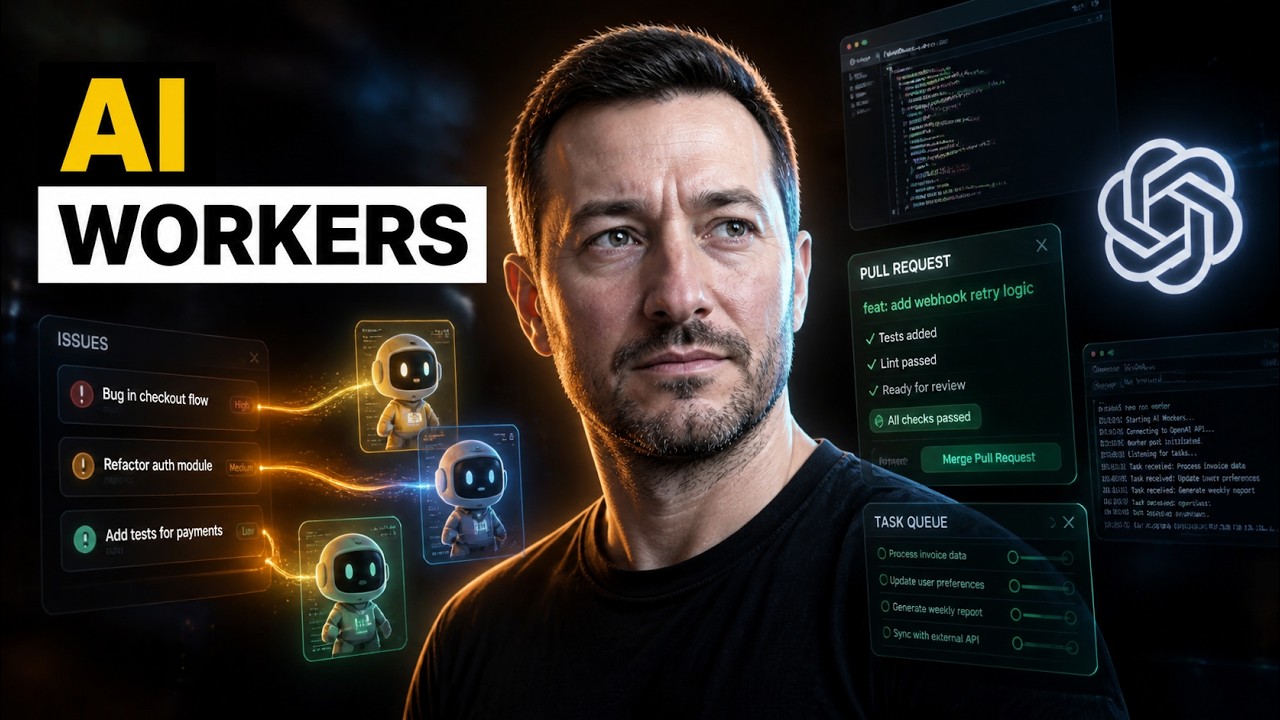
2:18little AI workers without losing our minds. That is why this new Open AI Symphony exists. Open AI describes Symphony as an agent orchestrator that turns a project management board like Linear into a control plane for coding agents. So, every open task gets an agent. Agents run continuously in a loop. Humans review the results. That sounds simple, but it changes the whole shape of software work. Instead of you opening five terminals and trying to remember which one is doing the settings page and which one is fixing the webhook and another one which one is breaking your off flow, of course. Your task board becomes the source of truth. Real quick, before we keep going, if you're
3:03watching this and you want to actually build with some of these tools, not just watch videos about them, then you're going to want to check out our community down below, Shipping School. We have a full Claude Code course, a full Open Claw course, and four live bootcamps every single week where we actually help you get set up from scratch. Like actually set this thing up, not just watch a tutorial and figure it out by yourself. And we also provide one-on-one coaching, so you could book a call with me. We could share screens and I can help you get Claude Code or Open Claw running on your machine. That's it, no fluff. I built this community because watching YouTube's only gets you so far. We launched it just 3 days ago and we have over 55 members. You need people around you who are actually building,
3:48people who hold you accountable, and coaches who can help you when you get stuck. I'll put the link in the description down below. Get in now before the price goes up. Each issue maps to a dedicated agent workspace. The system watches the board. If work appears, an agent can pick that work up. If an agent stalls or crashes, Symphony can restart it. If a task is blocked, it will just wait. This is not just coding help. This is a workflow design. And here's why I care about this so much for non-technical builders. Because most people using AI to build apps are still thinking prompt by prompt. That's kind of the old way. They open ChatGPT, right? We all do that. We open Claude Code. We open Codex or Open Claw or whatever Hermes or whatever you're
4:33using. And they say, "Build me this feature." Right? That's just what we're used to. Then they paste the errors in back and forth troubleshooting hoping it work. Then the context gets crazy messy and confusing. Then they do not know what had changed, which can be a problem. Then you'll have to eventually start over. That can work for a weekend. It could work for half building an app, but it does not scale into a real business. A real business needs actual tasks and organization, you know, priorities, review, approval logs, ownership, rollback, basic tests. Basically a way to say, "This is done and this is blocked and this needs human input." That is what Symphony is basically pointing at. AI agents need a work system around them. The agent is not the product at all. The system around the agent is the product. Open AI
5:18says Symphony decouples work from sessions and pull requests. That matters because a task is not always one PR. Sometimes one issue creates multiple PRs across different repos. Sometimes it is just research. Sometimes it's a plan. Sometimes it's a tree of dependent tasks where one thing has to happen before another thing can even start. And if you try to manage all that inside of a single chat window, you're going to get errors. You're going to make mistakes. The context has become a huge mess. The chat window is like texting a contractor, right? Useful for quick questions. Terrible as the entire construction management system. If you are remodeling a house, you do not text the electrician, right? I mean, come on. Think about it. You don't text the plumber, the painter, the inspector in a
6:03giant group thread and hope the kitchen gets done. You need a plan. You need a sequence. You need a dependency. You need someone to say the drywall cannot start until the inspection passes. I always like to create the metaphor of when we're building workflows, we need to lay a foundation. Because a lot of these workflows are like actually building real structures, you know? You need a foundation. And if you don't have a solid foundation, your workflow is going to fall apart. So, one of the strongest claims in Open AI's post is that Symphony resulted in a 500% increase in landed pull requests on some teams. I'm always careful with numbers like that because every company has its own setup, its own baseline, its own
6:48team habits. But even if you do not copy that exact result, it's the direction that matters here. The more output got changed, right? The workflow got changed. But it didn't just get changed by asking for a better model. And that's the lesson here. Most people are waiting for the next model to save them. The models are so good at this point, we need to actually learn how to use them to our best ability. They're tools and they're all really good now. Open AI is basically showing that orchestration matters just as much. Probably even more. Because once models are good enough to handle tasks, which they are at this point, your advantage comes from how you feed those tasks into a certain system. You know, are they clear? Are they scoped? And are they testable? Are their dependencies even marked? And is
7:35there a review step? Does the agent even know when to stop? Can it file follow-up work instead of bloating the current task? The last piece is huge here. The Open AI post says AI agents can create work themselves. During implementation or review, if they notice a performance issue, a cleanup opportunity, or a better approach, they can file a new issue for humans to evaluate later. So, now they're assigning work to us. That's crazy. So, that is how you avoid the classic agent problem where it starts fixing everything it sees. You do not want an agent turning a button color task into a full design system rewrite because it found something annoying. You want it to stay on task, then create a follow-up issue if it sees something worth doing. That is grown-up agent
8:22work. We're seeing this progress massively over the last few months. And it connects perfectly to what we talk about with Open Claw. The magic is not in just that the agent can do stuff. While it is impressive, the magic is that the agent can live inside your actual workflow. It can read context. It can run tools. It can follow rules, create tasks, it can wait for approval, and come back later. And it works 24/7. That is the difference between a cool demo and an operation. So, what should you take from AI Symphony, right? If you are building your own thing. Like how do you use this? How can you implement something like this? You need to stop treating your AI agent like a vending machine, essentially. You do not just insert one giant prompt and expect a finished company to fall out. Treat it like a worker inside of a process. You
9:08know, you've seen the meme before, you know, build the a million-dollar business, make no mistakes. I mean, we're getting to that point, but we're not there yet. The second thing is you need to write better tickets. If you want agents to work well, the task has to be clear. What needs to change, what should not change, and what test proves it works. What files are actually relevant and what does it even mean when it says done? If you're struggling to keep up with content, I'm about to save you about 40 days worth of work. [music] I built something called Content Machine. It's 10 AI agents that run on the Open Claw orchestration and they handle everything. Scripts, thumbnails, [music] X posts, blogs, outreach, clips, newsletters, all of it. So, I went from 1,000 subscribers to 4,000 subscribers
9:54on YouTube in 7 days using this exact system. Every single morning I wake [music] up and the content's already done. I spend maybe 15, 20 minutes reviewing and approving them and I move on with my day. It works for [music] any niche, fitness, finance, real estate, marketing, whatever you are building and it is 100% completely customizable to your use case. So, you get the mission control dashboard, all of the cron jobs, everything I've built over the last 40 days helping me gain more and more people [music] to subscribe and join the community. So, you plug in your own thing and it molds it to you. It learns how you talk and it writes so it doesn't sound like AI slop. [music] $97 one time, it's not a subscription. I'll put the link down below and you'll thank me
10:39later. The second or the third thing is separate planning from execution. Ask the agent to make a plan. I always use Claude Code when I'm making a big change in plain mode because I get to see what it's doing and then I get to review the plan. Then, I'll let the agent break that plan into smaller tasks. I have it do it one by one until completion. That is way safer than asking the agent to do it all in one shot. The fourth thing is make review the default. OpenAI says humans review the results and that is the right model. Humans in the loop is not going away. Agents should create the work but humans still need to decide what actually ships to production, especially when the app touches money, users off, or private data, or anything that can break trust. The fifth thing is build around your task board. Linear,
11:25GitHub issues, Notion, Trello, whatever you use. The point is not at the specific tool. The point is that work should live somewhere structured, not only inside temporary chat history. This is where a lot of people are going to get it wrong. They are going to see Symphony and think that the answer is more agents or a better model. 10 agents, 20 agents, right? 100 agents, that sounds cool but more agents without a work system is crazy chaos and you're going to be spending so much in token spend. The real unlock is not the number of agents and it's not the model. It's the clarity of the system they operate inside. One good agent with a clean task queue, tests, and review, and memory can beat 10 agents running around with vague instructions. We have seen this over and over again. The boring workflow always
12:11wins because it's reliable and I think OpenAI is basically saying the same thing here, whether they frame it that way or not. They are saying the future of coding agents is not you babysitting a bunch of tabs. It is your existing work tracker becoming a place where agents can actually pick up work and do the work and create follow-up work and wait for humans when needed. That is the massive shift in workflows and that's how you become more consistent and more reliable when you're treating agents as a service. It also means founders need to get better at manage. I mean, not just prompting. If you're going to have AI workers, you need to know how to write tasks. You need to know how to prioritize those tasks. You need to know how to judge acceptance criteria criteria. You need to know when to say no and that stuff used to sound really
12:56boring but that is how you get more out of AI. In the boring stuff, unfortunately. You know, no one wants to do the boring stuff, right? But the money's made in the boring stuff and I've always said once you build the boring part laying the foundation, it just works. So, my take on this whole thing is Symphony is not important because everyone should cop an OpenAI exactly. It is important because it shows the next layer of your stack. The first layer was the model, the second layer was the coding agent, third layer was orchestration, workflows, tickets, state mechanics, things like that. But the stuff that turns an AI helper into an AI team, you know, that's the difference. We don't want it to melt your brain and for builders, this is good news because you do not need to wait for some magic future model to start using this idea or concept. You can start today, put your work in
13:42issues, scope the task tighter, have the agent plan first, make it open and available as a PR, review it before you merge it, and let it create follow-up tasks instead of making every task bigger. That is how you go from playing around with AI to actually shipping something that you could sell. OpenAI just gave the market a pretty clear hint. The next big jump is not just smarter agents. It is managed agents, organized agents, agents that know where work lives and what done actually means. And if you can build that muscle and get used to building this way, you're going to be way ahead of the people who are just pasting the same error over and over inside of a chat box thinking that it's the ninth time it's going to get fixed. You know, this whole space is changing a lot. Every day, every week,
14:28it's hard to keep up but I know that the barrier to entry is getting a lot lower and that's amazing. You know, I love playing around with AI but it's really important to build the right workflow and use that workflow to be able to build your business or build a business to serve another business, right? So, I got the link to the post down below. You really should check it out. Give it to your agent, see what it thinks about it, how you can implement it in your open claw, in your Hermes, in your Claude Code workflow, or your Codex workflow. This is what we talk about all the time in our community. We do nine live calls a week inside of our shipping school community. We also have a local LLM call where we learn and talk about how to install local machines and, you know, hosting local models cuz I do believe that's where everything's headed. So,
15:13check out the community down below. We have a nearly 200 members that have joined and I launched it about 38 days ago. Also, if you haven't subscribed to the channel already, what are you waiting for? I release videos just like this about two to four times a day. Hit subscribe and we'll see you in the next video. Be blessed.
Build this with us, live
Shipping Skool is a free community with 4 live build sessions a week. Bring your idea.
Join Shipping Skool — Free